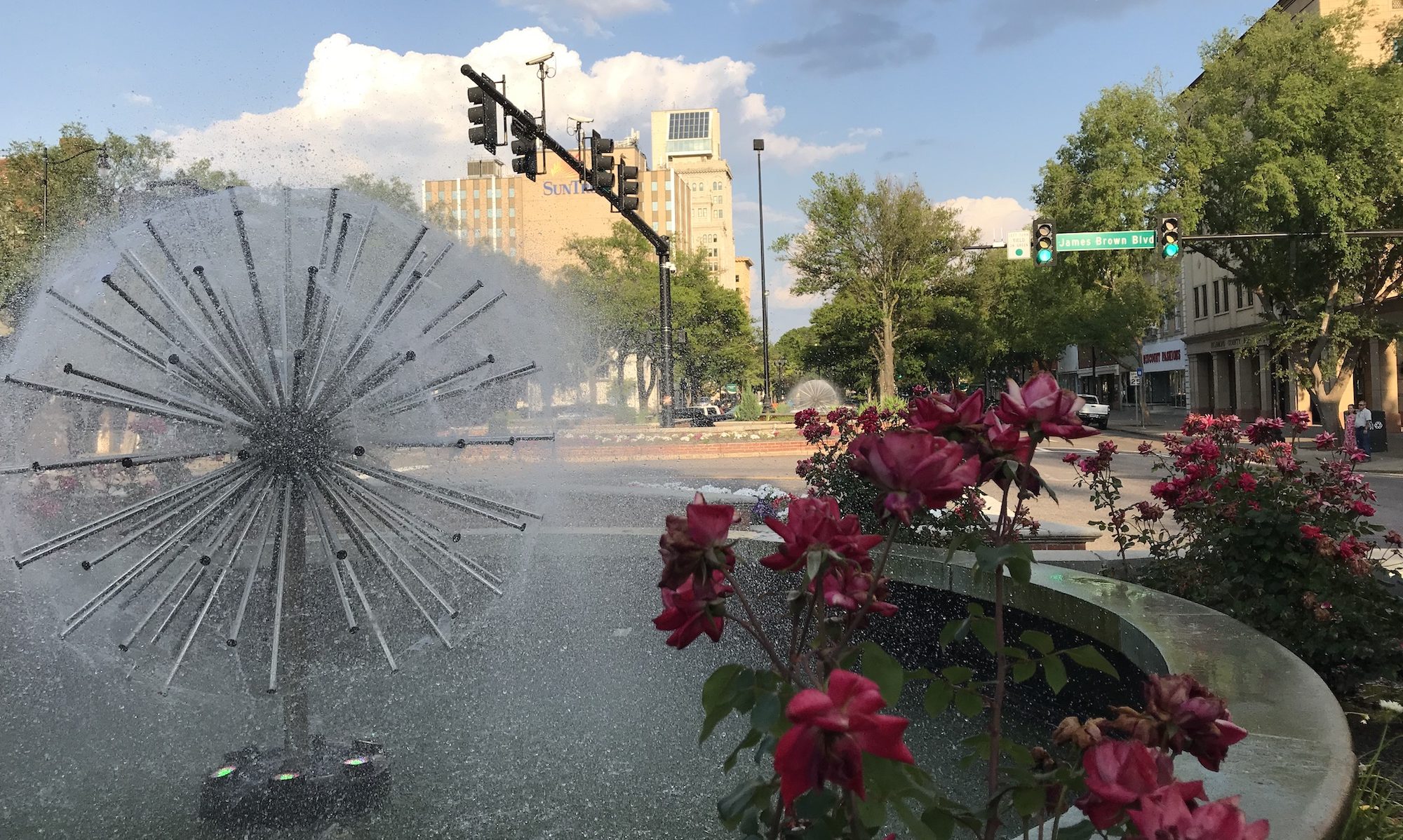

My newest book, published in August 2025 from Louisiana State University Press, is titled Sandhill Cities: Metropolitan Ambitions in Augusta, Columbus, and Macon, Georgia. It examines metropolitan and regional development in and around three midsize cities in the 20th century. These and other smaller cities, especially in the South have been neglected in U.S. urban history scholarship, as Richard Harris argues in his 2019 essay on the state of the field in the Journal of Urban History. My book is part of an emerging body of work that is exploring how the history of smaller cities forces a reframing of many assumptions in the field that sprang from scholarship weighted preponderantly toward the largest cities.

Sandhill Cities focuses on the three cities along Georgia’s stretch of the fall line, the natural slope dividing the Piedmont from the coastal plain and also a boundary that largely shaped the growing social chasm between white and black. It covers primarily the 1910s-80s and examines the slow abandonment of these cities’ roles as markets, suppliers, and service centers for traditional agriculture dominated by cotton, their continued economic reliance on farm, forest, and mine products, and their pursuit of the hydroelectric and navigation possibilities of their rivers and the tourism and recreation potential of their landscape and climate. It also explores the impact of heavy militarization and the tension between the cities’ embrace of a romanticized, problematic history as a foundation for tourism and their efforts to lure diversified industrial, office, and healthcare investments. These cities were part of the emergence of the modern South and the nation’s transformation into a “consumer’s republic,” but their leaders looked to the future on their own terms, tailoring their strategies in ways that revealed local preoccupations and the weight of tradition and social division.
My research in Georgia for Sandhill Cities benefited from two Faculty Scholarship Initiative awards from the Office of Research at Cleveland State University as well as the CSU-AAUP Travel Fund. An award from the John Nolen Research Fund supported research in the Division of Rare and Manuscript Collections at Cornell University Library. Presentations of portions of this project at the Urban History Association conference in 2018, the 18th National Conference on Planning History (SACRPH) in 2019, and 19th National Conference on Planning History in 2022 were also helpful. Three articles emerged from this research, but none became chapters in the book. The first, “‘Green Spots in the Heart of Town’: Planning and Contesting the Nation’s Widest Streets in Georgia’s Fall Line Cities,” appeared in the Winter 2020 issue of Georgia Historical Quarterly. The second, “Making ‘The Garden City of the South’: Beautification, Preservation, and Downtown Planning in Augusta, Georgia,” was published in the Journal of Planning History in May 2021. The third, “‘A Wonderful World?’ C&S’s Georgia Plan, Urban Renewal, and Historic Preservation in Savannah, Augusta, and Macon,” appears in the Spring 2025 issue of Georgia Historical Quarterly.
Advance Praise
“In this rigorously researched and nicely narrated book, J. Mark Souther has given us portraits of three mid-sized cities in the middle of Georgia. It is a story of ‘effervescent boosterism’ and its disappointments, of the gap between image and reality, and of civic ambition and its limits. There are important lessons here for cities all over the country that find themselves in the shadow of a larger metropolitan cousin.”
—Steven Conn, author of Americans against the City: Anti-Urbanism in the Twentieth Century
“A model of comparative history, Sandhill Cities reminds us that the twentieth-century urban South was more than the experience of Sunbelt notables such as Atlanta, Charlotte, and Houston. By juxtaposing the development of Augusta, Columbus, and Macon, Sandhill Cities reveals that boosters in mid-sized cities regularly articulated a metropolitan vision for their cities but struggled to realize those goals.”
—LeeAnn B. Lands, author of Poor Atlanta: Poverty, Race, and the Limits of Sunbelt Development
“Mark Souther is among the nation’s most eminent urban historians. In Sandhill Cities, he tells a complex, important story of urban boosters in Augusta, Columbus, and Macon, Georgia, as they sought to emulate Atlanta’s fantastic growth, starting in the 1900s and extending to the 2020s. The book is conceptually sophisticated, lovingly written, and richly documented.”
—Mark H. Rose, coauthor of A Good Place to Do Business: The Politics of Downtown Renewal since 1945
“The American South is littered with small cities that make you wonder—how did that lonely skyscraper get here? Sandhill Cities tells the story of economic dreams and anxieties in Georgia’s Augusta, Columbus, and Macon, all caught in Atlanta’s shadow. Souther’s account points to a broader regional history that explains cities too often bypassed until now.”
—Anthony J. Stanonis, author of New Orleans Pralines: Plantation Sugar, Louisiana Pecans, and the Marketing of Southern Nostalgia
Contents
Introduction
ONE ~ The Heart of Georgia
TWO ~ The Winter Capital of America
THREE ~ Metropolis of the Chattahoochee Valley
FOUR ~ Planning “The South’s Most Progressive City”
FIVE ~ What Augusta Builds, Builds Augusta
SIX ~ Building the Future from Our Past
Epilogue: Where Soul Lives
Louisiana State University Press
288 Pages / 6.00 x 9.00 x 0.81 in / 28 halftones, 4 maps
Hardcover / 9780807184899 / August 2025
eBook / 9780807185155 / August 2025
 Mark Souther