My public history practice began modestly more than 25 years ago when I worked as part-time tour guide at a historic house museum in Richmond, Virginia, while I was an M.A. student at the University of Richmond. My year at Agecroft Hall, a reconstructed Tudor manor, coincided with a major interpretive shift in the museum from emphasizing material culture to a broader focus on the social history of Tudor and Stuart England. During my Ph.D. work at Tulane University, I became involved as a research assistant for an NEH-funded planning group that ultimately established a regional humanities center at Tulane.
I was hired by Cleveland State University in 2003 on a 20th-century U.S./public history line, and my initial responsibilities in the latter included teaching Introduction to Public History and relaunching the history department’s internship program. Two years later, I collaborated with Mark Tebeau on a transit-oriented public history project that resulted in touchscreen kiosks in transit stations on Euclid Avenue that interpreted the street’s history through text, images, audio, and video.

This project led to the development of a major oral history project now popularly known as Cleveland Voices. Formally titled the Cleveland Regional Oral History Collection, Voices is a dynamic project that continues to work with faculty, students, and regional partners to conduct and share oral histories. To date, the collection has amassed more than 1,300 streamable interviews in more than 50 series.

With Tebeau, I was active for several years in a series of U.S. Department of Education grant-funded Teaching American History workshop programs, notably The Sounds of American History. This work led us in 2008 to co-found the Center for Public History + Digital Humanities (CPHDH), for which I have served as director since 2013. We also created Cleveland Historical, a mobile app designed to expand the curation of places across the Cleveland metropolitan area. Like Voices, the app has been a tool for teaching and public engagement and a component of dozens of community partnerships from Detroit Shoreway to Shaker Heights. Cleveland Historical features nearly 850 location-based stories.

The project also became the pilot for Curatescape, a mobile publishing framework that generalized the app’s codebase for wider use. Developed in the Center with support from NEH, the Ohio Board of Regents, and CSU, Curatescape now supports numerous app projects worldwide, ranging from small historical societies to major universities.
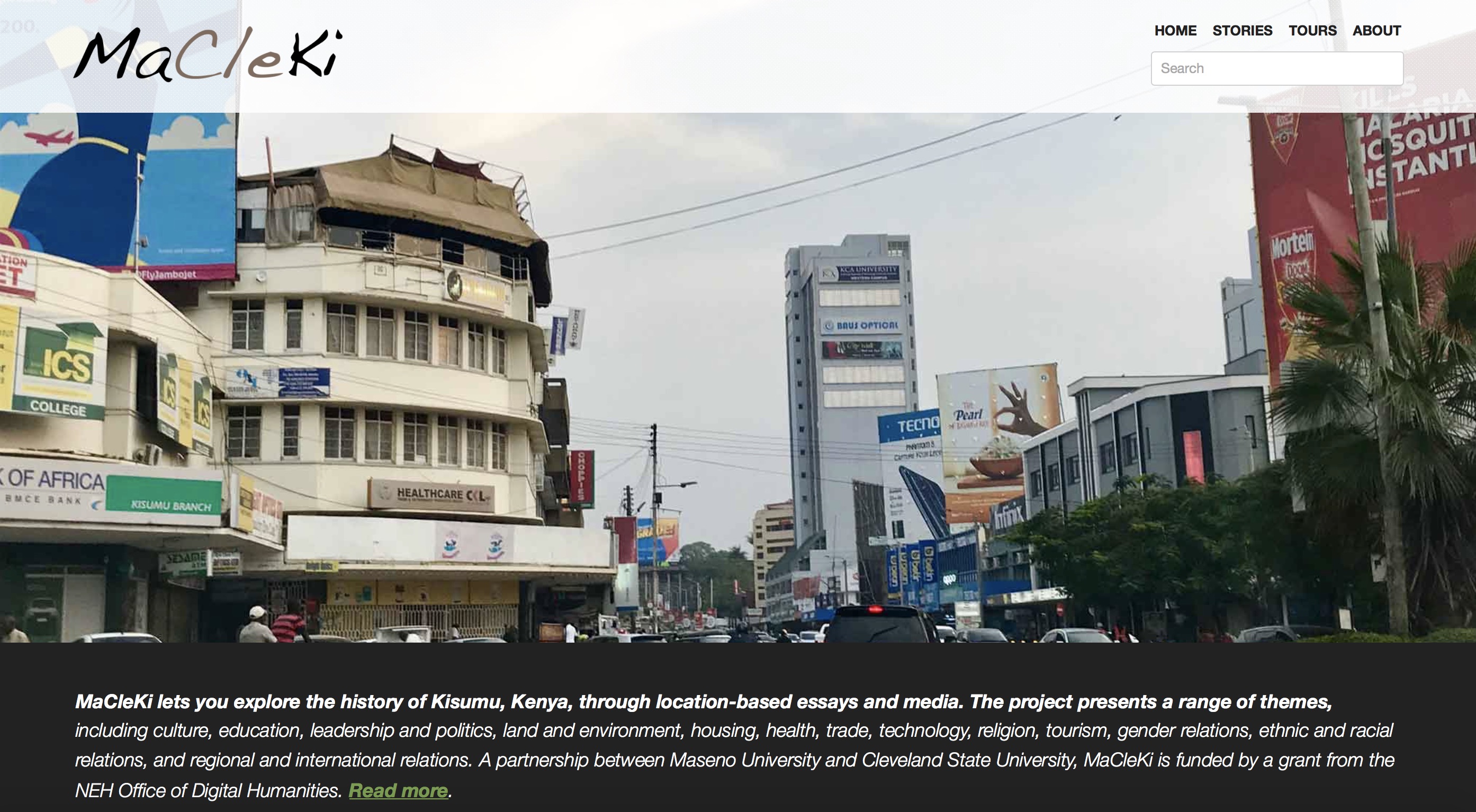
With another colleague, Meshack Owino, I directed the Curating Kisumu / Curating East Africa project, a partnership between CSU and Maseno University in Kisumu, Kenya, that began with an NEH Digital Humanities Start-Up Grant in 2014-15 and continued with additional investment by CSU in 2015-16 and an NEH Digital Humanities Advancement Grant in 2017-18. A central component of Curating East Africa was to build Curatescape for WordPress, a single plugin and theme that promised to revolutionize digital storytelling in the developing world by lowering barriers that divide ambition from adoption of digital humanities practice, beginning in East Africa. In addition, MaCleKi, the pilot for the Curatescape for WordPress platform, features 54 location-based stories about Kisumu that were collaboratively written by students from Maseno University and Cleveland State University. (For more on the results of the project’s, see our NEH white papers for Curating Kisumu and Curating East Africa.)
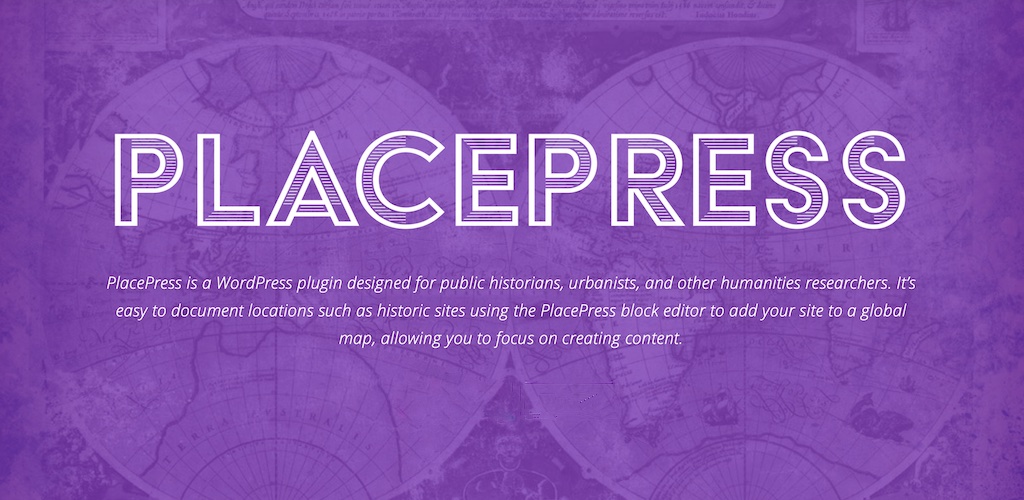
More recently, Erin Bell and I completed an NEH Digital Humanities Advancement Grant project in 2022 titled “PlacePress: A WordPress Plugin for Publishing Location-based Stories and Tours.” The PlacePress plugin offers a free, intuitive, flexible, and sustainable means for humanities and social science scholars, students, organizations, and communities to create and share map-based tours on any WordPress-based website. Project partners in Detroit and western Pennsylvania piloted the plugin. The University of Oregon Libraries coordinated remote user testing of the plugin, which is available in the WordPress Plugin Directory.
Green Book Cleveland is a restorative history project that combines Victor H. Green’s famous travel guides, published between 1936 and 1966, with new research that expands our understanding of Black entertainment, leisure, and recreation in Northeast Ohio. The project emerged in August 2021 and has expanded into a community of practice with Akron Zoo, Cleveland Metroparks, Conservancy for CVNP, Cuyahoga Valley National Park, Ohio & Erie Canalway, Summit Metro Parks, ThirdSpace Action Lab, Trust for Public Land, University of Akron, and Western Reserve Land Conservancy. It has been funded with a National Park Service Civil Rights Grant and a National Park Foundation–Mellon Foundation Humanities Postdoctoral Fellowship.
In addition to my work as the director of CPHDH, I have served as a grant reviewer for three NEH grant programs and have provided consulting for numerous public history projects and museum exhibitions. I also have have been active in the area of historic preservation. I wrote successful National Register of Historic Places nominations for Grant Deming’s Forest Hill and M.M. Brown’s Mayfield Heights historic districts in Cleveland Heights, and I served from 2011 to 2023 on the Cleveland Heights Landmark Commission.
 Mark Souther